

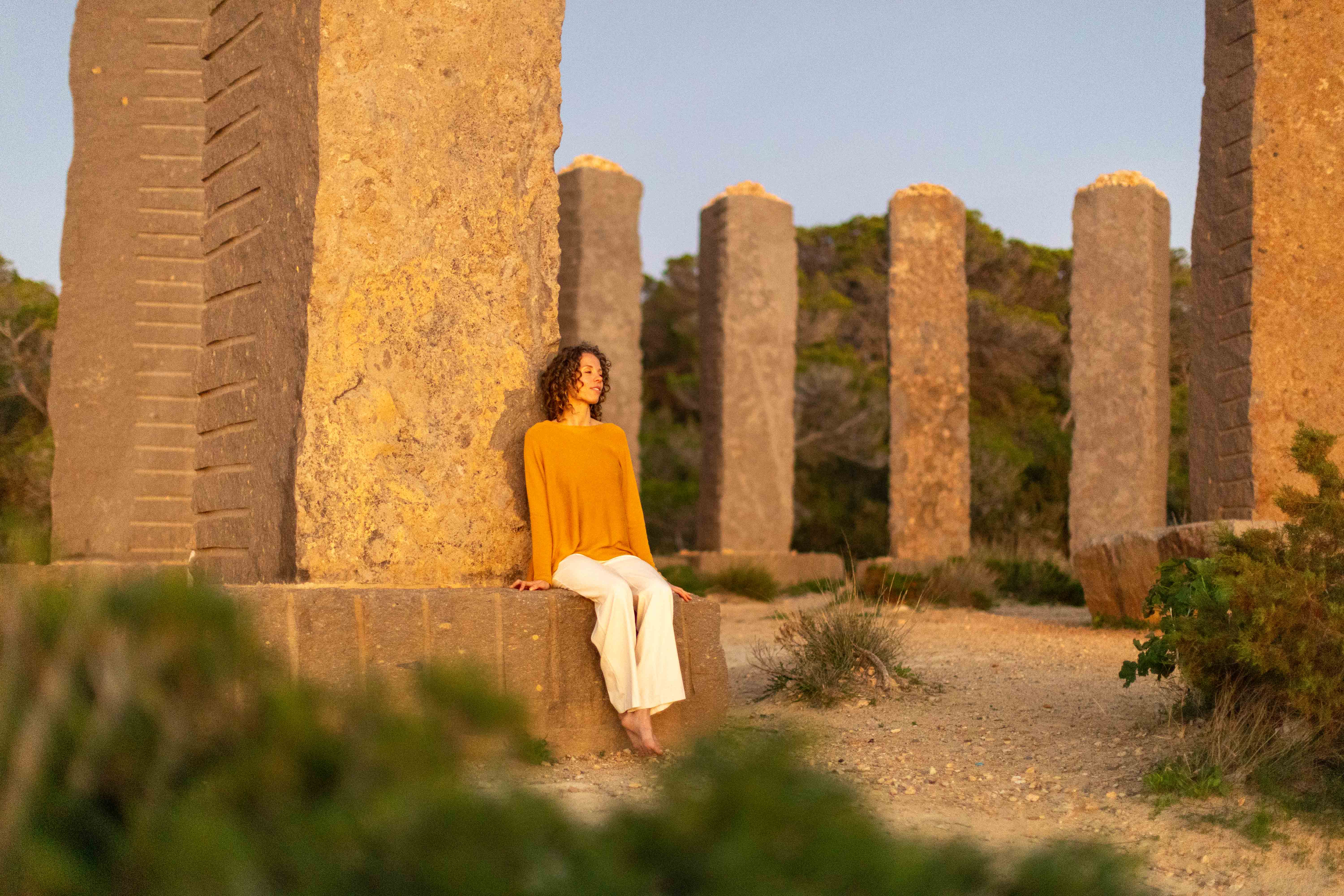
Sophie Heldens is a Tantra teacher based in Berlin whose path into this ancient tradition began with an unexpected moment of profound self-recognition—an experience that set her on a year-long journey across India and Southeast Asia. What followed was an intensive period of study and embodied exploration: teacher trainings, Vipassana sessions, deepened asana practice, guidance from modern and classical Tantra teachers, and her own first sessions offered in India and Thailand.
Today, Sophie facilitates Tantra workshops, courses and retreats for individuals and couples, creating spaces that invite presence, vulnerability and heartfelt connection. In this exciting conversation with Lumaya, she reflects on her personal transformation, her search for authentic lineages, and how she bridges classical Tantric philosophy with modern practice. She also shares her perspective on desire, self-love, and the evolving role of Tantra in a rapidly changing world.
Your mirror-moment: You recount a spring day in Berlin when you looked in the mirror and felt an overwhelming surge of self-love. How did this moment shape your commitment to Tantra, and what role does self-love play in your life today?
Self-love is the anchor, vehicle and destination on my journey of self-discovery. It allows me to explore my depths, including the parts of me that I rather not look at. It allows me to welcome experiences that I'd otherwise pass on because of self-doubt or fear of getting hurt. Yes, I might get hurt and I might fail–but it will never make me doubt my own worthiness. This removes the importance of what others think of me. To be internally referenced rather than externally gives me a lot of freedom! It allows me to show up for my mission even though it means exposing myself vulnerably.
Before the mirror-moment that you're referring to, I knew nothing about Tantra. I had not spent any thought about Tantra or had any desire to explore this direction (other than having verbally expressed some curiosity when I was at the start of my 20s). Right after experiencing this heart-opening moment, it came to me that Tantra is what I’d want to discover for myself and share with the world. Because of some other signs that came in that moment, leading up to that moment, as well as afterwards, I never doubted the truth of it. I have not looked back ever since :)
Searching for authentic teachers: Which teachers and lineages have influenced you most, and how do you weave classical wisdom with modern practices?
I am trained in modern Tantra - this lineage comes from Osho. I find however that some things do not align with the classical teachings that I come across in my private studies where I mostly follow the work of Christopher Wallis (scholar of Kashmiri Shivaism). The Tantric philosophy that he shares is very much aligned with my life view and offers a broad opportunity for contemplation. With my offers I invite the participant into their own experience and contemplation through modern practices. I share about Tantra's history and philosophy while addressing common misconceptions. My offers often focus on topics that are popular within modern Tantra, offering context and an experience through which the participants get to tap into their own wisdom.
A year of self-discovery: You quit your job, left home and spent a year studying with different teachers. What were the most important insights from that journey, and how are they reflected in your workshops today?
What I noticed most clearly is a change in my way of being and interacting. Already within the first two months after leaving Berlin, I told my mum spontaneously on the phone that I love her. Something I had never spoken out loud because it was not part of our upbringing. It was not planned. My heart was open and before my mind could creep in, I heard myself speak those words. Tantra is very much about allowing the natural flow of life. Releasing the conditioning of the mind that otherwise prevents us from doing so.
I feel more, I express more, I allow more, I dare to be more vulnerable, I trust even more in something greater than myself, I feel free, authentic, natural, open. I feel (even more) distanced from the societal conditioning that predicts how I should be living my life, that the world is to be feared, that humanity on this planet is doomed, that certain things are impossible etc.
This year of self-discovery allowed me to go deep into my own process and to truly embody what I am teaching today.
From fear to freedom: In your blog you describe realizing that a “fear of attachment” had been sabotaging your relationships. How did Tantra help you transform that fear into confidence, and what practices do you recommend for people facing similar issues?
Any practice that invited me to engage with others. In slowness and silence, observing myself in these connections has led me to first observe and from there release and transform what was coming up for me. As I like to say: Tantra invites you to see yourself and turns everything that is not yet love into love. Shadow work is an essential part in Tantra as this is where our greatest potential lies. To observe yourself and to become present with your inner experience is a part of every practice
Transformative tools: You write that Tantra has helped you face your fears with presence and to let go of stories and beliefs. What practices do you suggest for beginners who want to open up to this process?
It is hard to recommend one practice for everyone–though any practice that supports presence is beneficial for your growth. When practicing presence with compassion, you’ll get to turn your shadows into gifts. Tantra is not a linear path–the path will be different for each person. The beauty is however that, in the way I organise my groups and retreats, every person gets to see exactly what is most relevant for the healing and expansion of the participant in that moment. Everyone finds their own treasures.
Beyond stereotypes: You point out that modern Tantra is often reduced to sexuality, even though its scope is much broader. How do you explain to people who only see the sexual aspects in Tantra the deeper aims of this tradition?
I share about the totality of Tantra- how Tantra includes every aspect of human life. How Tantra recognises this manifested realm as an embodiment of the divine and not something that is separate from it. We can meditate on all aspects of it and through that tap into expanded states of consciousness. In this totality, sexuality is not excluded but also not overly highlighted.
Desires: In one of your articles you argue that desires are not obstacles but opportunities. How do you distinguish between desires arising from a sense of lack and the divine desire to express one’s fullness?
Iccha-shakti is the desire to share yourself with the world–to express yourself–to experience your inner fullness. Raga desire (desire coming from a contracted experience of Self) is the desire to fill yourself with something external: to fill the void we often experience as humans. To distinguish between the two one can ask themselves the question: Am I doing this out of love for myself or out of a sense of lack. We don't have to condemn ourselves for our Raga desire–they are part of our path of self-discovery. We can fully live out our raga desires unconsciously with the result of only creating more suffering for ourselves, until we eventually learn that they can’t fulfill us. Or, we go into them with deep presence, find where they originate from and allow them to take us into the experience of our inner fullness. All raga desire boils down to wishing to experience this inner state of fullness.
Self-reflection: One of your questions for self-reflection is “Am I doing this out of love for myself or out of a sense of lack?”. How has this question changed your decision‑making?
I generally don't ask myself this question but it is something that I like sharing with others who have a harder time distinguishing what they truly want. We can literally apply it to anything. Are you wearing makeup to celebrate your beauty and as a way to express yourself, or because you otherwise don't feel good enough? Do you participate in that self-development course because you want to fix yourself or out of love for yourself? Do you lift weights to take care of yourself or because you want to be perceived as strong or masculine? Do you go to Berghain to forget about your problems or to celebrate life?
Vipassana versus Tantra: You note that Vipassana works “from the outside in,” whereas Tantra works “from the heart outward”. What has this insight taught you about the differences between these two paths, and why did you ultimately stay with Tantra?
It is not a choice made from the mind. I was never made for Buddhism but until Tantra came to me, it was the only path I knew. I did enjoy the linearity of Vipassana, especially after dipping my toes in the Tantra world and feeling quite disorientated because of its vastness. The practice of Vipassana focuses mainly on the mind whereas Tantra focuses more on the heart. Some will feel more inclined to the practice of Vipassana. For me, the heart is where my greatest power lies.
Balancing discipline and devotion: How do you combine disciplined practice with devotional openness to cultivate both groundedness and ecstasy?
I use discipline to cultivate more presence. This presence allows me to notice what is supportive and what is not. Once we get to a state of deep continuous presence, we can let go of discipline and operate from this presence instead. We can flow with life rather than becoming rigid. My devotion to my mission, spirituality and health allows me to be disciplined–the presence that I tap into allows me to get into a state of flow where I want to do my spiritual practice because the moment calls for it rather than because I know that it is best for me.
Creating safe spaces: What measures do you take to ensure that singles, couples, beginners and experienced practitioners all feel respected and held?
It is threaded throughout the entire workshop or retreat. Being present, grounded and heart-open as a facilitator invites the group to do the same. I invite them to welcome emotions, challenges and triggers. I create a step-by-step journey that allows people to gently open and go at their own pace. With every single group, we explore consent and boundaries. This work allows people to create more space to hold their own experiences–finding more safety within. I never work alone, I always have capable people supporting me and the group. In the end, it is a space that we co-create. I tend to facilitate heart-opening. When the group taps into that, we create a space that is deeply nourishing and healing for everyone.
Tantra for couples: You offer coachings, tantric date nights and private day retreats for couples. What changes have you observed in relationships when couples integrate Tantric practices?
Practicing Tantra as a couple can be deeply enriching. You will grow as individuals and as a couple. All the growth that I've been through on my personal journey, you can experience in a relationship. Two people doing this work, opens the door to a conscious and deeply loving relationship. Instead of connecting mind-to-mind, you'll be connecting heart-to-heart. Instead of communicating with words, you will commune heart to heart. It allows for spontaneity, joy and eros. Instead of looking for love with each other, you will find an abundant source of love within yourself and together you’ll share in the experience of love.
Handling skepticism: How do you handle criticism or skepticism from those who misunderstand or reject Tantra?
That is none of my business :) Everyone gets to walk their path. Tantra is not for everyone and that is okay. We all need to be discerning on our path. If we are all expressions of one consciousness but all have a different perspective onto reality–then, since our starting point differs, it is only logical that each of us has a different path to walk to realise that one consciousness. The destination is the same, the path is different. At that moment, I felt clearly that Vipassana is not for me personally. Though I deeply respect the practice and have experienced some of its benefits. And, though I think it's unlikely, a day might come that I find it time to go for a fourth Vipassana.
Future vision: How do you see the future of Tantra in the German‑speaking world?
It is said that in 2027 all of our jobs can be done by AI. For some, this is a fearful realization. I see it as an opportunity. How can AI take over all of our jobs? AI has no heart, no essence. If anything, it is going to show us even more clearly the power of the heart and the beauty of life's essence. Anything that does not need heart or divine beauty–AI can do. Anything else, only humans can do. Yes, we will experience chaos–but it will be there to guide us back to our essence: that is what makes us human. Tantra offers ways to experience our humanness in the most beautiful way.